

We’re Jeremy Hermann and Duncan Gilchrist, and we’re all about data products. Today’s post explains what we’re up to at our new venture, Delphina.
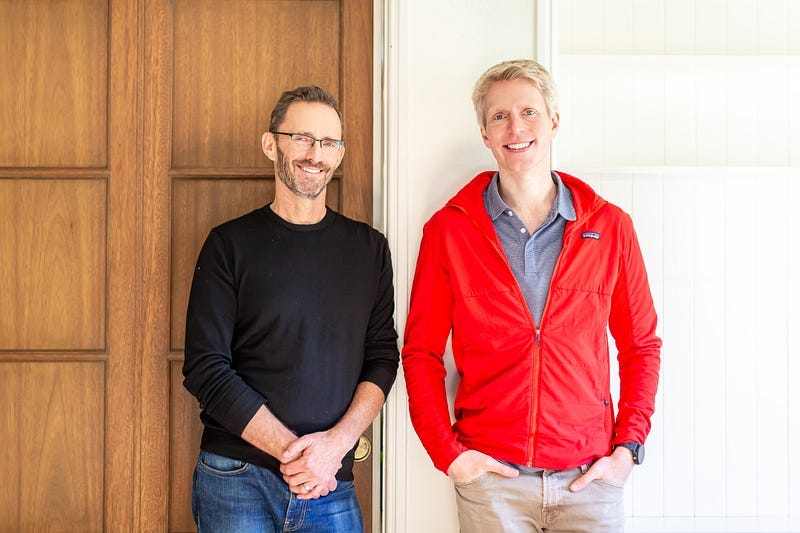 Jeremy Hermann and Duncan Gilchrist
Generative AI is poised to transform nearly every industry and discipline — including data analytics itself.
The recent, headline-grabbing advancements in large language models (LLMs) and deep learning algorithms have created an unprecedented appetite for investing in machine learning and predictive AI. According to Deloitte, 94% of business leaders agree that AI is critical to success over the next five years.
But data experts know the truth: no amount of hype will speed up the painstaking process of understanding, preparing, and analyzing data. Their days are full of manual data wrangling, answering repetitive questions, and frustrating bottlenecks. And there’s a huge talent gap — right now, there aren’t enough data scientists and analytics experts in the world to meet the demands of every ambitious CEO hustling to gain a competitive edge.
Within the last 10 years, the core questions businesses ask of their data have become well-understood — revenue drivers, customer behavior, operational efficiency, forecasting. These should be straightforward. But although clear best-in-class statistical approaches exist, every organization’s data team must start from scratch learning the idiosyncrasies of their own data. Data scientists within every organization have to recreate the wheel every time to do this painstaking work.
Or worse, the talent simply isn’t available.
Data science moves slowly — even at Uber — but leaves an impact like a crater
We know this firsthand from our time at Uber. Duncan led data science teams — first in the Ridesharing Marketplace, and then at Uber Eats — and Jeremy led the Data Platform team and then the Machine Learning platform team that built Michelangelo, Uber’s groundbreaking ML infrastructure.
Uber had hundreds of data and applied scientists and thousands of engineers to build their sophisticated infrastructure and enable data science and analytics to flourish across the business. Our colleagues included superstar academics like Garrett van Ryzin and Peter Frazier, a rotating cast of consulting professors from Stanford, and, in 2021, even 20% of the graduating class from the Harvard economics PhD.
But even with this multi-million dollar, talent-stacked data team, getting business results out of data was still really hard.
It was standard at Uber for a two-pizza team of engineers and data scientists to be focused on advancing just a few different areas. It might take a quarter or more for them to do a complex analysis or make a substantial update to an ML model.
For example, take Estimated Time of Arrival (ETA) modeling for Uber Eats. It would take quarters to analyze how well it was working today, and then to build and test an obviously good idea, like incorporating a restaurant’s menu information into the predictive model. That’s because working with the data itself was a painstaking process: we needed to sift through thousands of tables to identify which had relevant data, analyze it to understand where the signal was, build features to summarize the important parts, train and tune the model, and finally work with partner teams to productionize.
Michelangelo, the ML platform Jeremy’s team built at Uber, handled the large scale training and productionization of machine learning models. It tied into Uber’s data systems and made it much easier to reliably ship models at Uber scale. But, Michelangelo didn’t simplify the hardest part of the workflow: understanding the data. Every new question — whether building a model, investigating a metric change, or answering an executive’s ad-hoc request — required the same painstaking process of discovering relevant tables, understanding what the data actually meant, and building trust in the answer. The company relied on legions of data scientists as the bottleneck for all of this.
Getting data right was easy to screw up. Wrong answers reached decision-makers. Some bets wouldn’t pay off at all. Yet with over $100B in gross bookings flowing through the network, even small positive changes were highly valuable. A major analysis or production model improvement from Duncan’s team would routinely deliver over $100m in annualized profit.
Data was worth doubling down on because for all its challenges, data science is transformational. It leaves an impact like a crater: profound and enduring.
 Generated with Midjourney
Introducing Delphina: using GenAI to change data science and analytics
Recent advances in data tooling — modern warehouses, dbt, BI platforms, commercial feature stores (including Tecton, co-founded by Jeremy in 2018, and acquired by Databricks) — improved the infrastructure, but the core bottleneck remained: the institutional context needed to work with data correctly. Across over a hundred conversations with companies from the Fortune 500 to startups, one truth rings clear: getting deep and correct answers from data is slow at the biggest companies, and next to impossible everywhere else.
Until now — thanks to generative AI.
With the latest LLMs, AI itself is now capable of handling many of the tasks involved in data science. Frontier LLMs now have a human-like ability to understand context and make common sense judgments, and can learn how to connect the dots between the data and the business.
For example, LLMs can understand table contents and business context, recognize which data is relevant to a question, write SQL for data aggregation, Python for more advanced data wrangling, and — critically — make the thousands of micro-judgments about data that previously required a senior analyst: which table to use, how a metric is defined, what filters to apply, which edge cases matter.
Now, it’s possible for AI to make judgments and micro-decisions about data — and automate much of the painstaking work that data scientists and engineers have had to do themselves. GenAI cannot replace data scientists but it can finally tackle the hardest part of their work: building and maintaining the contextual understanding of data that makes accurate analysis possible.
That’s why we created Delphina: an AI-powered platform whose core focus is the context layer — the institutional knowledge about what data means, how metrics are defined, and which business rules apply — so that AI agents can answer analytical questions reliably. Gone are the days of painful semantic layer tooling — Delphina’s context layer is AI-built and AI-managed, making it incredibly simple to set up and keep up to date.
The slow, error-prone, labor-intensive tasks that once took weeks or months and had to be completed by a human expert will be completed by Delphina within minutes.
Ask Delphina what churn trends are, and not only will Delphina give you the number, it will actually unpack the number into a multi factor analysis — explaining what’s different and has changed across regions, products, time periods.
By leveraging LLMs with expert guidance, Delphina accelerates the full analytics workflow: connecting to all the tools in your stack, understanding questions, documenting data and tribal knowledge, and continuously validating that answers remain correct as data evolves.
We’re already seeing adoption of Delphina in business team roles including marketing, sales, finance, operations, customer success and more. Interestingly, many of our top users are executives — including multiple CEOs — who were previously largely prohibited from touching their company’s data themselves. But they know exactly the right questions to ask and so, paired with Delphina’s AI-managed context layer that gives the right answers, they have superpowers.
Delphina gives every enterprise — with and without large data teams — the ability to get reliable, trustworthy answers from their data, delivering the kind of analytical capability that was previously only possible at companies like Uber.
Join us on our mission to help the world get better at data
We’re excited to announce we’ve raised $7.5m in seed funding from some of the savviest investors in AI to make this vision a reality.
Thanks to our VC leads at Costanoa Ventures and Radical Ventures, and over 20 prominent angels including Fei-Fei Li (Professor of Computer Science at Stanford), Lukas Biewald (Co-founder & CEO, Weights and Biases), Alison Rosenthal (early Facebook), and Guido Imbens (Nobel Laureate & Stanford Professor) who believe in what we’re building.
Curious about our mission? We’re hiring, so check out our open jobs.
Or if you’re interested in taking Delphina for a spin at your company, don’t hesitate to write us at info@delphina.ai.